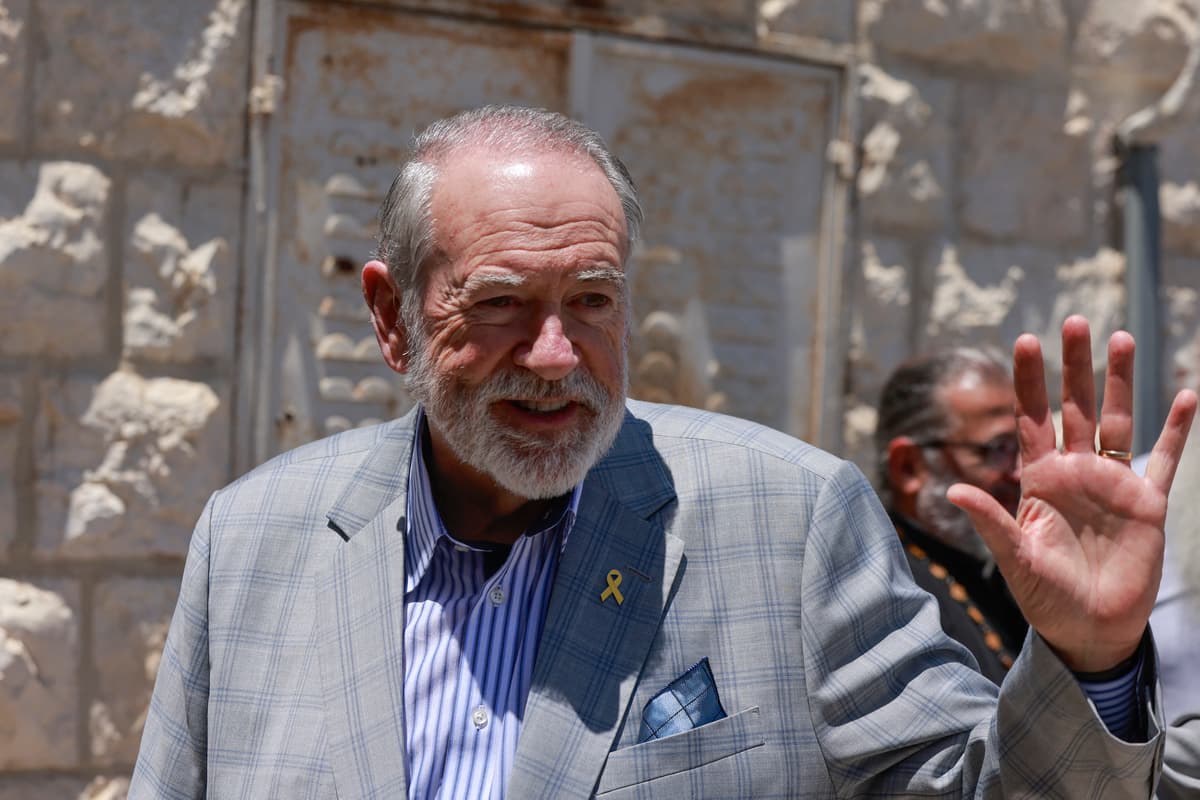
Ten doctors from Ukraine are participating in a specialist course at the Ophthalmology Clinic of the Medical University of Lublin. The meeting, which coincides with another groundbreaking event, was organized by Professors Robert Rejdak from Lublin and Andrij Zimienkowski from Lviv. Wojciech Brakowiecki spoke with them.
This visit is connected with the 65th anniversary of the publication of the research of Professor Tadeusz Krwawicz, a native of Lviv. Professor Krwawicz graduated from the Lviv School and the University of Lviv. He obtained his doctorate there and completed his studies before moving to Lublin.

“The professor was born in Lviv in 1910, and this part of his life in Lviv, until 1944, is like a blank spot,” says Prof. Zimienkowski. “In Poland, the time he spent in the Lviv region was never well known. I am interested in the history of medicine and have gathered information about the Lviv period of this eminent professor’s life. He came from a mining family and his relatives wanted him to be a miner too. However, when he fell ill with pneumonia, he observed the work of the doctors who were treating him. He said that he also wanted to be a doctor. His father was a wise man and helped him achieve this. He came to Lviv from Kalush, a small town in the Carpathians, where he was studying to be a miner. In Lviv, he began studying at the Faculty of Medicine at the Jan Kazimierz University. He did his doctorate at the Department of Histology. He didn’t think about eyes, he only thought about surgery. Something didn’t work out in surgery. It was about tissue. Maybe that’s when he had ideas about freezing tissue. I don’t know.
This tissue freezing is precisely the method that the professor discovered. Without exaggeration, it can be said that it was a revolution in medicine.
“It was indeed a revolutionary approach to cataract surgery,” admits Prof. Rejdak. „Let me remind you that Professor Krwawicz collaborated in this area with the father of Professor Zbigniew Zagórski. Professor Zagórski’s father built the first lens cryoextraction device. The philosophy itself was to first freeze the lens with a special tip. It turned into a lump of ice, allowing the lens to be safely removed by damaging the ligament mechanism on which the lens is normally suspended in a controlled manner. This prevented additional complications. I would like to emphasize that exactly 65 years ago, the first results were published in the British Journal of Ophthalmology, a periodical with a global reach. For 20 years, this method was basically the standard worldwide.
The word spread.
“Yes, I know from my colleagues, including my teachers at the Lublin Clinic, that doctors from all over the world came to Lublin to study,” says Prof. Rejdak. „It was the 1960s, under the previous regime, a gray period, but people came to us from the United States, basically from all over Western Europe, to learn this method from Professor Krwawicz. It was used for a very long time. I think that there are still some isolated procedures in the world that are performed using this method. Let us remember that it was a breakthrough, it was the first idea, but also contact with the broad field of eye surgery, hence the strength of our center.
Today, the power of the Lublin center, located on Chmielna Street, is being transferred to other regions of the world, Europe, and Ukraine, because doctors from Lviv, among others, are trained here.
“This is the main idea behind the Interreg NEXT project, which we are implementing with Professor Rejdak,” points out Prof. Zimienkowski. “Let’s look at the symbolism: Tadeusz Krwawicz was always innovative. These ‘bridges’ began in 1944, when Krwawicz returned to Lublin, and Professor Rejdak is passing on his knowledge to doctors, Ukrainian doctors, and ophthalmologists from Lviv. This is also innovation. In all these projects, it is not the equipment that is most important, but the partnership. And these innovations, because you don’t have to go to Germany, you don’t have to go to the United States, you can come to Lublin and receive world-class knowledge in the field of modern ophthalmology.
This knowledge stands at a very special moment, because we are talking on the eve of a very sad anniversary, namely the start of full-scale war in Ukraine.
“This is certainly one of the most important areas of our activity,” emphasizes Prof. Rejdak. “I was always taught in Lublin, at the Medical University, but also at the Ophthalmology Clinic, to think globally and act locally. On the one hand, we have this great tragedy, the war, but on the other hand, there are specific people and specific places that need help or regular, ongoing cooperation. We are pleased that, under the auspices of the Medical University, we have launched the Interreg Health Bridges project. Locally, this means Lublin, Lviv, and Lutsk. This is where the doctors come from, this is where the real cooperation comes from. We are also pleased that we have government and European Union funds that these three border centers can use in a very concrete way. Specific doctors come, equipment is purchased, experiences are exchanged, but there is also a digital platform that allows us to conduct teleconsultations.
Just as Professor Krwawicz’s method was revolutionary, medicine is constantly changing and developing, and in ophthalmology, not everything has been said yet.
“Indeed, ophthalmology is developing very rapidly. We are a field in which basically every year brings some new therapy or modification, thanks to which we can treat more and more patients, and by that I mean more and more diseases,” says Prof. Rejdak. “I remember my early days, when in the case of all macular diseases, we would tell the patient: we are sorry, there is nothing we can do. Now we have the beautiful European Center for Innovative Therapy of Macular Diseases on Chmielna Street, in the Chrzanowski Palace. The main clinic was established after the war at 1 Chmielna Street, so we are continuing this work in a beautiful location, under excellent conditions, and using equipment of the highest global quality and standard.
You are passing on all this knowledge, even now in Lublin, to other doctors from Ukraine.
“Of course, I will mention that we have just had a congress attended by over 400 doctors from 14 countries, but cooperation with Ukraine is a very important area,” says Prof. Rejdak.
Thank you very much for this interview, Professors Andrzej Ziminkowski from Lviv and Robert Rejdak from Lublin.